





By Christian Ordóñez, Specialist in Advanced Technology Solutions
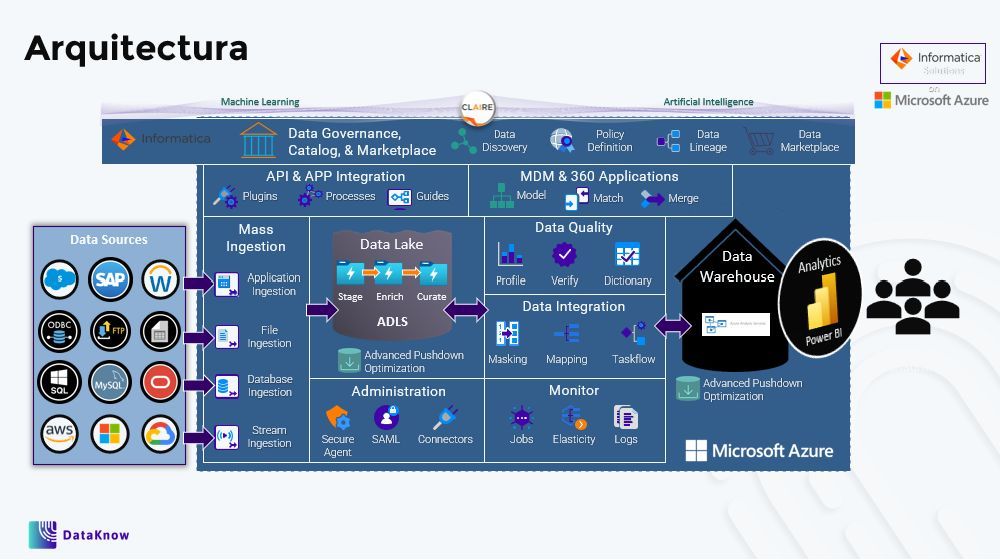
In this article, we explore a significant evolution in the world of data management: Data Fabric. By 2024, this concept has become an integral approach for companies aiming to optimize their data handling, offering a flexible and efficient architecture that integrates various information sources.
The main goal of Data Fabric in 2024 is to reduce human intervention in data management by incorporating capabilities such as active metadata management and cloud deployment support. Additionally, artificial intelligence (AI) plays a crucial role by automating real-time insights and data monitoring.
Among the key benefits of using AI in Data Fabric are:
Advanced Automation
Advanced automation through AI and machine learning optimizes data integration processes more efficiently and accurately than manual methods. These algorithms can identify patterns in data and make decisions based on predefined or learned rules, leading to faster and more accurate integration of multiple data sources.
By minimizing human intervention in data integration processes, the risk of errors and biases is reduced. AI algorithms can automatically identify and correct discrepancies or inconsistencies in data, ensuring its quality and reliability.
Advanced automation allows scaling data integration processes to handle increasingly large volumes of information without proportionally increasing human resources. This is particularly useful in growing business environments or industries generating large amounts of data, such as finance or e-commerce.
Improved Decision-Making
Data Fabric provides fast and centralized access to a wide variety of data, enabling decision-makers to obtain relevant information in real time. This gives them a more comprehensive and up-to-date view of the situation, facilitating informed and strategic decision-making.
With integrated advanced analytics capabilities, Data Fabric enables complex analyses and the discovery of hidden patterns or trends in data. This provides users with a deeper understanding of the factors influencing their operations and helps them make more accurate and effective decisions.
By enabling more efficient data management and more agile decision-making, Data Fabric helps organizations adapt quickly to market changes or business environment shifts. This keeps them competitive and allows them to seize new opportunities as they arise.
Positive Return on Investment
By automating processes and improving efficiency in data management, Data Fabric helps reduce operational costs associated with data integration, cleansing, and analysis. This translates into significant savings over time.
The automation of repetitive tasks frees up time and resources, allowing staff to focus on higher-value activities. This increases the productivity and effectiveness of the organization as a whole.
By providing quick and reliable access to high-quality data, Data Fabric enables organizations to maximize their information, which can lead to new business opportunities and greater growth. This results in a positive return on investment that far exceeds the initial costs of implementing and maintaining Data Fabric.
In the 2024 landscape, Data Fabric is undergoing a transformation with an increasing emphasis on consolidation and automation. AI plays a critical role in this evolution by automating real-time insights and data monitoring.
Future perspectives include advanced automation and AI pushing Data Fabric into an era of more autonomous data management. It is crucial for companies to adapt to this evolution to remain competitive and agile in the market.
In summary, 2024 marks a turning point in enterprise data management with the evolution of Data Fabric. This transformation is essential for companies seeking operational efficiency and better data-driven decisions. It is an exciting time to lead innovation in data management! If you want to learn more or implement Data Fabric in your company, contact us.